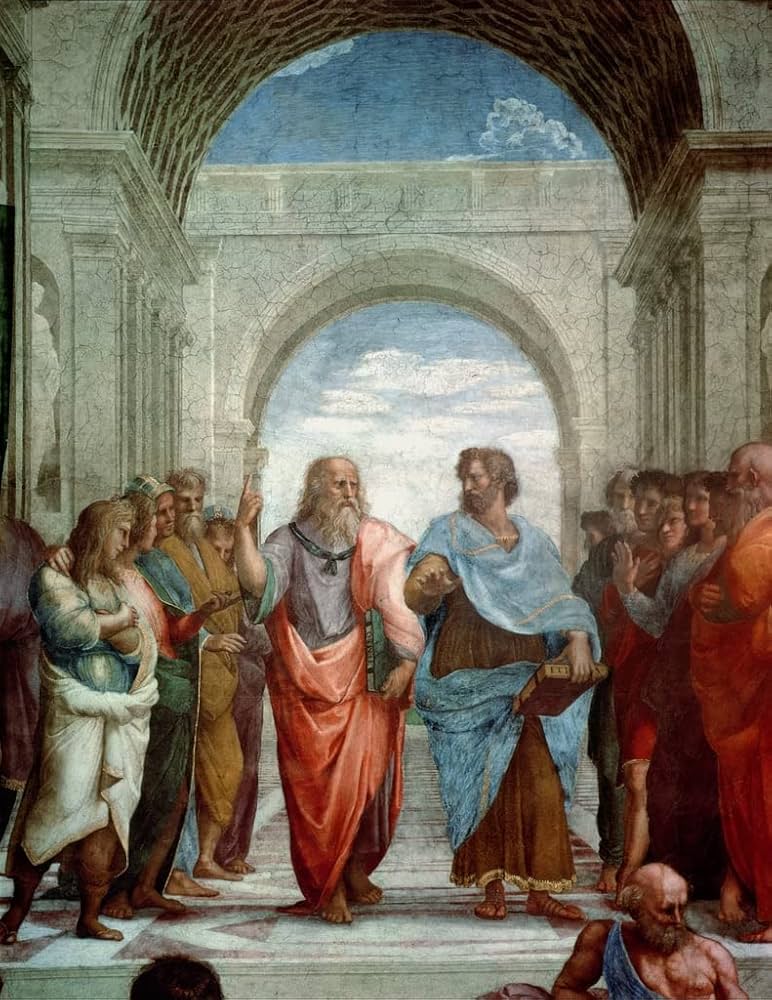
This first part of the book review of “Things Glorious and Ruinous” discusses Chapter Four: “What Does the Classical in Classical Education Mean?”
The Parthenon, according to Mark Signorelli, embodies the ideal of the classical idea by emphasizing symmetry, balance, and harmony over the “copiousness or abundance of design element evident in the Baroque [cathedral] façade.” Mark Signorelli claims: “[T]his notice of restraint [evident in the Parthenon], this willingness to suppose some degree of local efflorescence so that the harmony could prevail over the whole, was the characteristic note of the classical.”
“Classical” is more than continuity with the past; it is more than something venerable or traditional. “[T]he term classical has a meaning thicker than this.” Classical, for Signorelli, “signifie[s] those spiritual exertions in which the note of restraint was evidently at work, tempering every centrifugal inclination toward excess with a constant centripetal concern for harmony.”
According to Signorelli, “[t]hat restraint that is the unique note of the classical is itself a consequence of profound intuition for the form and essence of things.” We need restraint because “[t]he danger of excess is not that it marrs our spiritual exertions but that it threatens to negate them altogether.” The classical ideal, Signorelli claims, “presupposes the validity of realist metaphysics—a philosophical framework that accords true representative status to terms such as substance and form and think that a true understanding of the world and ourselves depends upon [sic] their proper application.” Classical is a way of thinking about human beings. This classical anthropology “informs the way we teach young huam beings as a consequence.”
For Signorelli, because “there is a certain form of restraint that is inherent to the classical ideal,” there “should be a form of restraint that is inherent to classical pedagogy.” What does this mean? It means that classical educators should teach students not to do certain things to “better enable them to do other sorts of things.” Classical educators “must train away the habits that would preclude their attainments of growth” by, for instance, prohibiting speaking disrespectfully to a teacher or another student, or creating consequences for students who neglect their schoolwork. A proper education precents students from being ignore, lazy, or self-centered and therefore involves certain kinds of prohibitions.
Signorelli comes up short here. His essay emphasizes the theoretical over the practical, that is, Signorelli spends time discussing realist metaphysics and exercising restraint consistent with human dignity but provides little practical guidance as to how classical educators should use restraint in their classrooms. More time here would make this a must read for classical educators, if it is not already.
But Signorelli is right on when it comes to why restraint should be used in classical pedagogy. For instance, here is a wonderful example of the purpose of the classical education: “Classical education aims to foster a child’s growth in virtue, to enable a young person to create with beauty, act with goodness, and think with the truth in mind.” In order to “enable students to progress toward that ideal, [classical educators] must actively train away habits and mentalities that tender toward the ugly and the vicious and the false.” This is the restraint required by the classical ideal that educators must understand and implement: “[A] restraint that emerges from a vision of the essential dignity of human nature and a recognition that the initial step in becoming the wise and good person prescribed by that vision is not to become something else first.”
Emil Dickinson agreed. Emily Dickinson’s poem, “Tell all the truth but tell it with slant” illustrates Signorelli’s belief about the importance of pedagogical restraint:
Tell the truth but tell it slant –
Success in Circuit lies
Too bright for our infirm Delight
The Truth’s super surprise
As Lightning to the Children eased
With explanation kind
The Truth must dazzle gradually
Or every man be blind –
For Dickinson, truth must be told allegorically, or symbolically, or both. Adults must tell the truth to their children, but it must be mediated out of kindness and necessity to those as yet too young or inexperienced to feel truth’s full power. According to Dickinson, the truth would make “every man be blind” if it is not told gradually through symbolic or allegorical statement.
But Dickinson does not stop with children. Similar to easing idea of lightning into the mind of children, Dickinson proposes to ease the lightning of truth for adolescents (students) and adults, those of us who are not children, to ease the “Lightning” strike of truth into her readers’ souls by an explanation that is told through allegory, symbolically, or some other way so that the truth is mediated for us. Dickinson’s claim to “tell the truth but make it slant” suggests that a poet may tell only part of the truth, the part that is acceptable her audience and thus requires restraint by the poet.
Signorelli and Dickinson write the same: restraint must be used when educating others. It cannot be given all at once. It must be restrained to allow the correct virtues and understandings to flourish.
I hope you enjoyed this post. Please let me know if you would like too discuss this more in-depth or discuss something else. See you tomorrow!
Ben Crittenden