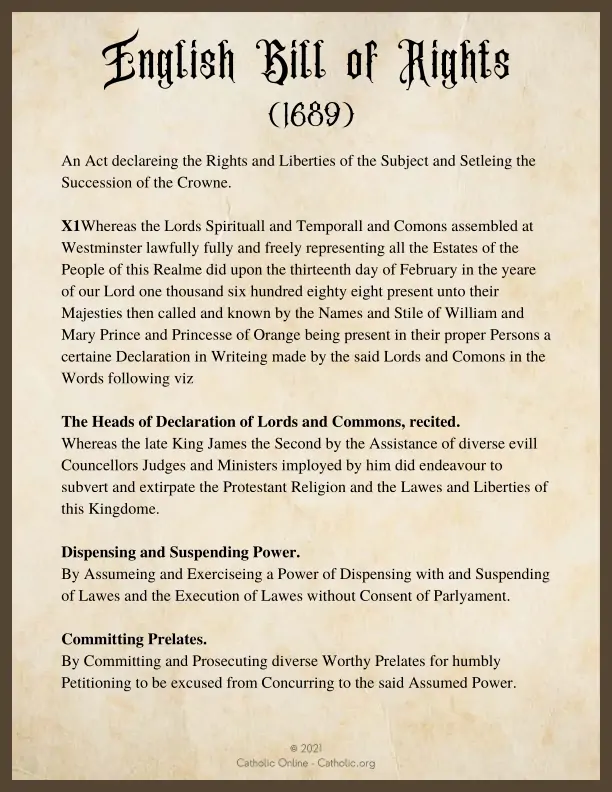
The English Bill of Rights was the first fruits of the Glorious Revolution in England in 1689. How did this Glorious Revolution happen? What was it? The Glorious Revolution in England followed a tumultuous period in English history. King Charles I was found guilty of treason and executed in 1649. After King Charles I’s execution, England established the English Commonwealth (1649-1660) with Oliver Cromwell as Lord Protector.
In 1660, the monarchy was restored. The restoration of the monarchy did not resolve underlying constitutional conflicts. King Charles II (r. 1660-1685) and King James II (r. 1685-1689) learned little from their father’s (Charles I) oppressive reign, treason trial, and execution. Both Charles II and James II (Catholic) tried to resurrect the idea of the divine right of kings. Both had consistent conflicts with Parliament.
In 1688, facing unified resistance from Parliament, King James II fled England. Parliament offered the throne to his Protest daughter, Mary, and her husband, William, Prince of Orange. This is commonly called the Glorious Revolution. The Glorious Revolution settled the constitutional struggles of the 17th-century. It secured the Protestant Reformation in England. It buried the absolutist pretensions of monarchs. Many of these results were explicitly ratified by Parliament in the Bill of Rights of 1689. The “Revolution” is called “Glorious” because of the results it achieved through an essentially bloodless change of power.
The English Bill of Rights of 1689 is the first fruits of the Glorious Revolution. It sets forth the liberties of the subjects that the parliamentary party had demanded for most of the seventeenth century. The English Bill of Rights specifically rejected the claims of royal absolutism. These claims were made by the Stuart kings (Charles I, Charles II, James II).
The English Bill of Rights is a forerunner of the limitations on the national government. These limitations would be written into the U.S. Constitution a century later. A few of its provisions would be incorporated into the U.S. Bill of Rights written in 1789. These include the right to bail (8th Amendment). The provisions also include the prohibition on cruel and unusual punishment (8th Amendment). Lastly, they involve the right to petition the government (1st Amendment). I should note that the U.S. Supreme Court has ruled. The 1st Amendment of the Bill of Rights does not guarantee a right to bail. It guarantees a right to reasonable bail if bail is set.

I hope you enjoyed this post. Please let me know if you would like too discuss this more in-depth or discuss something else. See you tomorrow!
Ben Crittenden