INTRODUCTION
The Church celebrates the Baptism of the Lord on the final Sunday of the Christmas season. The Baptism of the Lord marks the beginning of our journey. We will explore the public ministry and the life of Jesus over the next 334 weeks in Year A. We move with the Church through the Gospel of Matthew.
THE READING
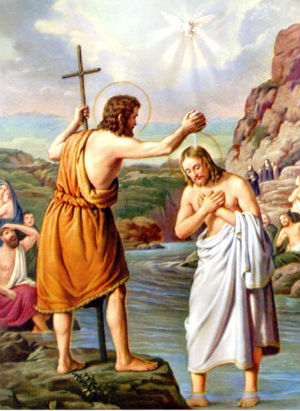
To mark the end of the Christmas season and begin the process of journeying through the Gospel of Matthew, the Church brings us to Matthew 3:13-17:
“Then Jesus came from Galilee to the Jordan to John, to be baptized by him. John would have prevented him, saying, “I need to be baptized by you, and do you come to me?” But Jesus answered him, “Let it be so now; for thus it is fitting for us to fulfill all righteousness.” Then he consented. And when Jesus was baptized, he went up immediately from the water, and behold, the heavens were opened and he saw the Spirit of God descending like a dove, and alighting on him; and lo, a voice from heaven, saying, “This is my beloved Son, with whom I am well pleased.”
The Holy Bible: Revised Standard Version, Catholic Edition, New York: National Council of Churches of Christ in the USA, 1994.
ANALYSIS
Several important things are happening in this reading. First, it marks the climax of John the Baptist’s ministry. It also indicates the beginning of the public ministry of Jesus Himself. Second, Jesus’ baptism take place in the Jordan River. The Jordan river is the eastern border of the Holy Land. It marks the places where the Israelites entered the Holy Land during their Exodus from Egypt. This happened when God parted the Jordan River. Third, Jesus’ is baptized to fulling Scripture and salvation history. When Jesus is baptized and goes down into the water, He comes up out of the water. The Heavens were opened. He sees the Spirit of God descending like a dove. Most of us may know that what’s happening is an anointing of Jesus with the Holy Spirit. He’s going down into the waters. The Spirit is coming upon Him. He’s being anointed by the Spirit of God. That’s what the Messiah is—the word christos, messiah, means “anointed one.” Just as David was anointed with oil in the Old Testament, Jesus—the true King—is being anointed now. This anointing is not with the oil from a horn like David, who had oil poured over him by Samuel. It is with the very spirit of God Himself coming down upon Him in the form of a dove. So we see here another echo. This parallels David being anointed king over Israel. However, Jesus is being anointed with the Spirit of God.
Fourth, “The heavens were open” echoes the Old Testament. In the book of 2 Kings we learn that Elijah was taken up into Heaven. This occurred after he parted the waters of the Jordan River. Elijah goes to the Jordan River at the end of his life. There, the Heavens open, and he is taken up into Heaven. Jesus…something similar happens to at His Baptism. In His case, watch this. This is really fascinating. It isn’t the waters of the Jordan that part so He can go into the Promised Land. It’s unlike the exodus from Egypt. The heavens open. This occurs in the same sense that Elijah went up into Heaven at the end of His life. So what is going to be the ultimate destination of the new exodus of Jesus? It’s not the earthly Promised Land. It’s the heavenly Promised Land. Elijah was taken there at the end of his life. This event happened at the Jordan River. Jesus is inaugurating a new Exodus with his baptism.
Fifth, the dove tells us there is a new creation. A dove appears for the first time in the Old Testament in the book of Genesis. It is in the account of the flood. In Genesis 8, you’ll recall that Noah and the ark come to rest on the top of Mount Ararat. The waters begin to recede. Noah sends out a raven that never comes back. And then he sends out a dove, and the dove brings back a freshly plucked olive leaf. And that olive leaf is a sign of the restoration of creation. After the waters of death destroy all human life. They wipe all of the sin out of the world. That’s what the flood is sent for in Genesis 6. Human beings have grown so sinful and violent. God sends a flood to cleanse the world of sin. Then God saves Noah and preserves him. After the flood, the dove comes down from Heaven to Noah with an olive branch in its beak. The olive branch symbolizes the new creation. Creation has been restored. New life has sprung up out of the waters of death that were the flood.
Just as life is the new creation, the olive tree emerged after the flood in the Old Testament. It came out of the waters of death. Now Jesus (watch this) emerges out of the waters of Baptism in the river Jordan. The Holy Spirit descends upon Him in the form of a dove to anoint Him with the Spirit. So what does this mean? It means that Jesus isn’t just inaugurating a new exodus. This new exodus will finally reach its destination in the heavenly kingdom. He’s also the beginning of a new creation, which will bring about a new cleansing of the world from sin. It’s through the waters of His Baptism, as we’ll see, that sin will be dealt with. It is also through our Baptism that sin will be cleansed.
Sixth, Jesus is the new Isaac. the image of Jesus as the new Isaac. Well, where do we see that? It’s in the very last line of the account of the Baptism here, when God says:
“This is my beloved Son, with whom I am well pleased.” (Matthew 3:17)
If you go back to the Old Testament, you might think about the image of a beloved son. The first person that’s going to come to mind is Isaac in Genesis 22. This is the famous story of the sacrifice of Isaac. When Father Abraham is told by God in Genesis 22:2:
“Take your son, your only son Isaac, whom you love, and go to the land of Mori′ah, and offer him there as a burnt offering upon one of the mountains of which I shall tell you.”
when Jesus comes up out of the water in Matthew 3 in the Baptism, and God says:
“This is my beloved Son, with whom I am well pleased.”
This reveals to us that Jesus isn’t just inaugurating a new exodus. He’s not just the beginning of a new creation. He’s also the new Isaac, the new beloved Son. He will actually lay down His life. This sacrifice is for all the nations of the world. Not just Israel, but the Gentiles as well, can be blessed. They will receive the forgiveness of sins. This is by the ransom for sins that His death will bring about on Calvary and on the cross.